County Government, KWRHP, Pamoja for Transformation, and Development Partners Unite to Strengthen Technical Skills
A transformative policy is taking shape in Bungoma County to overhaul Vocational Training Centres (VTCs), addressing critical gaps in skills development, youth unemployment, and local economic growth. The Vocational Training Policy, spearheaded by the Bungoma County Government, is being developed through a collaborative effort that includes Pamoja for Transformation, Kenya Workers Rights and Harmonization Program (KWRHP) , and a coalition of other civil society and education stakeholders from across the county.
The initiative, currently at an advanced consultative stage, aims to create a formal regulatory framework for the county’s 89 VTCs, spread across 45 wards, which are considered essential for equipping young people with practical, job-ready skills. A recent stakeholder engagement brought to the fore significant challenges facing the institutions, including the absence of a comprehensive policy framework, inadequate staffing, limited training equipment and infrastructure gaps, and inconsistencies in service delivery.
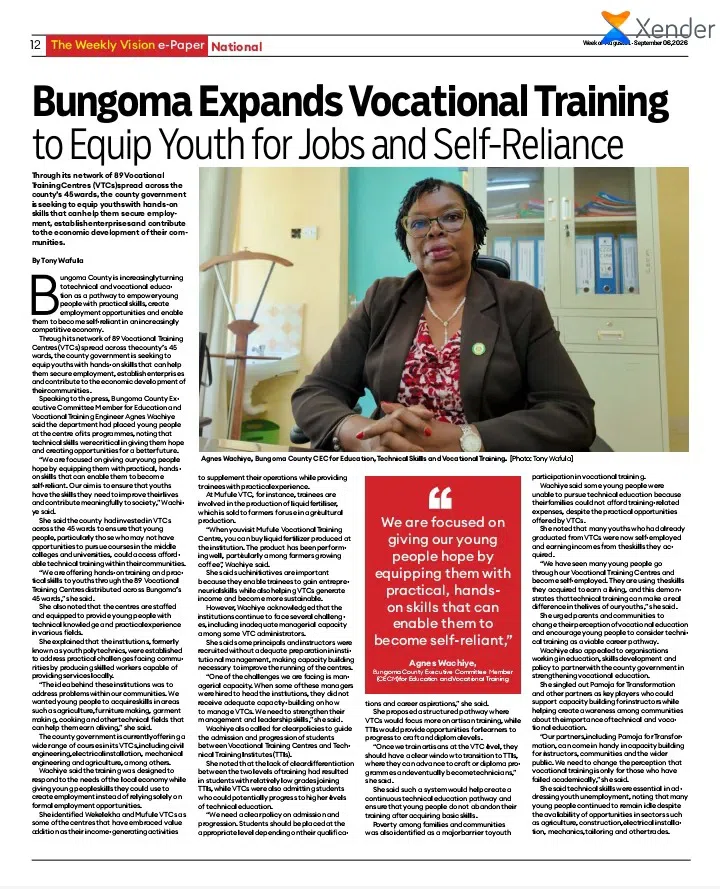
In response to these challenges, the County Executive Committee Member (CECM) for Education and Vocational Training, Engineer Agnes Wachiye, confirmed that the policy draft is already under development. She emphasized that the county is focused on giving young people hope by equipping them with practical, hands-on skills that can enable them to become self-reliant. The goal is to ensure youths have the skills they need to improve their lives and contribute meaningfully to society, rather than relying solely on formal employment.
The proposed policy is expected to create a clear pathway for students, differentiating between artisan training at VTCs and higher-level programs at Technical Training Institutes (TTIs). Engineer Wachiye noted that the lack of a clear progression framework has led to confusion, with students with low grades sometimes joining TTIs, while VTCs admit learners who could progress to higher technical education. “Once we train artisans at the VTC level, they should have a clear window to transition to TTIs, where they can advance to craft or diploma programmes and eventually become technicians,” she stated.
Stakeholders like Pamoja for Transformation have been instrumental in driving the policy’s development, advocating for evidence-based reforms that link training to economic opportunities. The Skills for Jobs (S4J) project, implemented by the organization, has provided employment and entrepreneurial skills to over 1,900 vulnerable youth in Bungoma, Kisumu, and Siaya counties, demonstrating the potential impact of a well-regulated vocational system . The project has supported technical training for nearly 2,000 youth and facilitated internships, job placements, and self-employment opportunities, proving that when properly structured, VTCs can be a powerful engine for economic development .
Kenya Workers Rights and Harmonization Program (KWRHP), a key partner in this initiative, is focused on ensuring that the policy not only addresses skills gaps but also protects the rights and welfare of workers in the informal sector, where many VTC graduates will eventually operate. KWRHP’s involvement underscores the link between decent work, fair wages, and accessible, quality training, aligning with the constitutional and international labor standards they advocate for.
The policy development aligns with national reforms under the Bottom-Up Economic Transformation Agenda (BETA), which has seen TVET enrollment surge from 297,000 in 2022 to 718,000 in 2025 . The national government is investing heavily in expanding technical training, with plans to build at least one VTC per constituency and recruit thousands of additional trainers. Bungoma’s new policy, therefore, represents a critical local implementation of this national vision.
County officials have also acknowledged the need to change community perceptions that vocational training is only for those who have “failed academically.” Technical skills, they argue, are essential for unlocking opportunities in agriculture, construction, electrical installation, mechanics, and tailoring—sectors with immense potential to absorb young job seekers.
The policy is also expected to strengthen the financial sustainability of VTCs. Some centres, such as Mufulle VTC, are already demonstrating the potential of income-generating activities, producing liquid fertilizer that is sold to local farmers. Such initiatives provide trainees with entrepreneurial skills while generating revenue to support their operations.
As the policy moves toward formal adoption, the county government has called for continued partnership with organizations like Pamoja for Transformation and KWRHP to ensure that the policy is not just implemented but also resourced and monitored effectively. This, they hope, will guarantee that Bungoma’s young people, particularly those from marginalized communities, are equipped not just with certificates but with the dignity and opportunity of decent work.